DOSSIER
Document
1
Signatories of the declaration say the need for governments to act on
human-driven climate change is too urgent to stay silent.
Oct 15, 2019 The scientist
Almost 1,000
scientists have signed a declaration supporting civil disobedience protests that urge government action on
climate change.
“We believe
that the continued governmental inaction over the climate and ecological crisis
now justifies peaceful and non-violent protest and direct action, even if this
goes beyond the bounds of the current law,” Emily Grossman, the first signatory
of the declaration and a science broadcaster with a PhD in molecular biology,
announced during a protest on Saturday (October 12), according to Reuters. Grossman, accompanied by other signatories, read the declaration outside
London’s Science Museum in Kensington.
“We
therefore support those who are rising up peacefully against governments around
the world that are failing to act proportionately to the scale of the crisis,”
she said.
Grossman and
the others who drafted the declaration support the Extinction Rebellion, a
non-violent environmental pressure group that formed in the UK about a year ago
to protest government inaction on the ecological crises caused by climate
change. The group, which sparked similar groups in dozens of countries around
the world, has had more than 1,400 protesters arrested in London in the last
week alone, and police ousted activists from Trafalgar Square on Monday
(October 14), the Associated Press reports.
“We can’t allow the role of scientists to be to just
write papers and publish them in obscure journals and hope somehow that
somebody out there will pay attention,” Julia Steinberger, an ecological
economist at the University of Leeds and a lead author of the sixth
Intergovernmental Panel on Climate Change report,
tells Reuters.
“We need to be rethinking the role of the scientist
and engage with how social change happens at a massive and urgent scale,” she
says. “We can’t allow science as usual.”
Document 2
We scientists must rise up to prevent the climate
crisis. Words aren’t enough
Our profession has been great at raising awareness. But this alone won’t
succeed against the might of the oil and gas lobbyists
As
scientists, we tend to operate under an unspoken assumption – that our job is
to provide the world with factual information, and if we do so our leaders will
use it to make wise decisions. But what if that assumption is wrong? For
decades, conservation scientists like us have been telling the world that
species and ecosystems are disappearing, and that their loss will have
devastating impacts on humanity. Meanwhile, climate scientists have been
warning that the continued burning of fossil fuels and destruction of natural
carbon sinks, such as forests and peatlands, will lead to catastrophic
planetary heating.
We have collectively written tens of thousands of
peer-reviewed papers, and shared our findings with policymakers and the public.
And, on the face of it, we seem to have done a pretty good job: after all, we
all know about the environmental and climate crises, don’t we?
But
while we’re now well informed, we haven’t actually changed course. Biodiversity
loss proceeds apace, to the extent that a million species face extinction
in the coming decades, and we continue to pump carbon into the atmosphere at ever faster rates.
It seems that knowledge alone cannot trigger the radical global changes we so
urgently need.
It was this realisation that incited us both to embrace activism,
and to take to the streets and engage in non-violent civil disobedience as
members of Extinction Rebellion. The refusal to obey certain laws has a long
and glorious history: from the suffragettes to Rosa Parks and Gandhi, many of
the 20th century’s greatest heroes engaged in non-violent civil disobedience to
win their rights.
Today, civil disobedience is again on the rise. And it
is working. The protests that shut
down four sites in London in April raised the climate crisis rapidly
up the political agenda, and into the public consciousness. The environment is
now the third most pressing
issue for British voters, above the economy, crime and
immigration: the UK parliament and half the country’s local councils have
declared a climate emergency,
and a zero-carbon target has been enshrined into law. We don’t know what policy
change will follow, but it is an encouraging start.
Young people have embraced the
movement, and grandparents, too. So have doctors and lawyers, farmers and
unemployed people. But not many scientists, which is odd given we probably know
more about the severity of the problems we face than anybody. Perhaps it’s
related to an unspoken assumption that if our job is to provide information,
then adopting a position will weaken our authority. In fact, research shows it doesn’t.
Alternatively, scientists may be
reluctant to rise up because there are “proper” channels for influencing
policy: you can vote, you can write letters and sign petitions, and if things
get really desperate you can walk from A to B on a sanctioned march. The
trouble is, these avenues aren’t working, and lobbyists for fossil-fuel
industries have far greater access to political decision-makers. In 2018, for
example, oil and gas lobbyists alone spent more than $125m (£100m) lobbying politicians in just one country,
the United States.
As scientists we have spent years telling policymakers
that we must change course, but they haven’t taken action. They may be starting
to now, but only because people have engaged in open rebellion, making it clear
that we will no longer accept inaction. Surely scientists have a moral duty to
join the masses, and rebel for life.
• Claire Wordley is a postdoctoral research associate
at the University of Cambridge, Charlie Gardner is a lecturer in conservation
biology at the University of Kent
Document
3
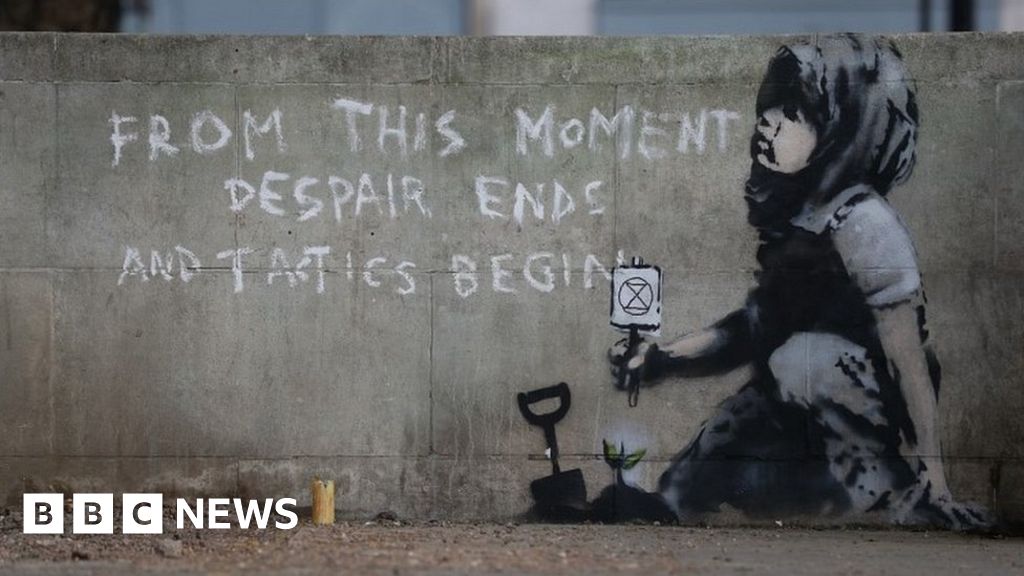
Extinction Rebellion Mural Could Be a New Banksy
Artwork, Expert Claims Recently
spotted at the climate activists’ Marble Ach base in central London. Apr 26, 2019 hypebeast.com
Class notes to help you:
1. An article taken from The
Scientist, dated October 2019 – an opinion piece /a column (written) by
Claire Wordley, a researcher at the University of Cambridge, published in The
Guardian in September 2019 along with a photo of a Bansky artwork posted
on
hypebeast.com in April 2019.
2.
Document 1:
-
A group of scientist have
signed a document
-
They aim to denounce government inaction on climate change
-
They support civil disobedience
= peaceful protest
-
Extinction Rebellion = a group
of activists whose goal is to
denounce gvt inaction on climate change
-
Originated in the UK, then
spread worldwide
According to Julia
Steinberger, an ecological economist, the role of scientists must be redefined.
Scientists need to be actively involved in public protest. She highlights the scale of the crisis
Document 2: Claire Wordley : put the
paragraphs in the correct order
-
People from all generations and
social backgrounds have joined Extinction Rebellion. However, many scientists
are still unwilling (reluctant) to get involved. They
believe that their role is only to provide information. But oil and gas
industry are much more powerful and have a greater influence on policymakers, hence the necessity for scientists to
take action and rebel openly against government inaction. 3
-
A successful (an effective)
means of action. In the UK, policymakers (decision-makers) and the public acknowledge that the environment must
be a priority. 4
-
Traditionally, the role of
scientists has been to provide
information and trust political leaders to take action based on their research.
Their goal was to raise public awareness
to current issues like the
extinction of species and ecosystems and the rising threat of global warming. 1
-
Yet little is being done to tackle the environmental crisis. As a result, scientists like CW have
become members of Extinction Rebellion which advocates non-violent civil disobedience. ( a historical means of
protest –Gandhi, Rosa Parks… )2
Document 3: Bansky’s mural : A
completer….
The mural depicts
Next to her there is
A message on the wall says: “
The young girl embodies (incarne) who
The small growing plant
symbolizes
The artwork highlights